
The Glendale Historical Society will meet on Tuesday, January 13 at City Hall at 7 p.m. We will have updates on the House and Garden Tour being planned for the spring of 2026, as well as a new program to recognize Glendale’s Century Homes. All are welcome to attend.
Recently, a former Glendale resident contacted the GHS and expressed a willingness to share her memories of growing up in Glendale in the 40’s and 50’s. Her memories, as told to a GHS member, are below. If you would like to share your memories or know an older resident or family member who would be willing to be interviewed for the Glendale’s Oral History Project, please contact the GHS at Glendalehsmo@gmail.com.
To find more pictures, maps, articles, and other items about Glendale’s history, please visit our website at www.glendalemohistoricalsociey.com.
Memories of Growing Up on Warwick Lane
An Oral History by Margaret (Michel) Block as told to Leslie Dill
December, 2025
I moved to Glendale when I was three and a half years old and left when I married at the age of 24 and moved away, so I lived there from 1942 to 1962. My maiden name is Margaret Michel and we lived at 855 Warwick Lane. I still have a group of friends from the neighborhood – we have gotten together over the years. I’m 87 and I’m the baby of the group. We now use FaceTime once a week.
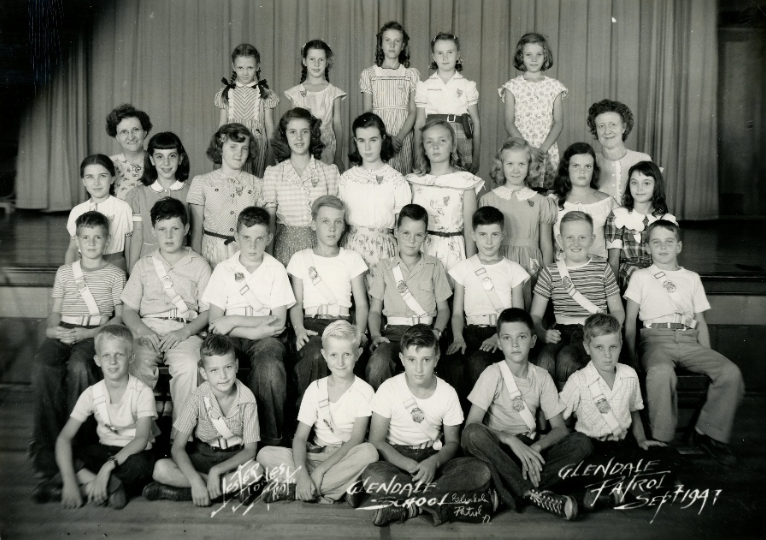
Above: 1947 Patrol Guard from North Glendale School
Margaret Michel Block who shared reminiscences from her childhood is pictured in the top row, second from left. Other friends who she continues to be in touch with are Roberta Mautz Pohl (second row from top, third from right) and Pat Lockwood Bleeker (second row from top, middle).
At that time, there were just three houses, and I would say a shack on the north side of the
street and it didn’t change until after World War II when they started building more
houses. The street actually ended out at a creek. On the other side, there were more houses. The man who owned all the property – Donnelly, we bought our property from him – had a small frame house and it was set back in the woods. Behind us, there were houses on Glen Elm and they went all around to Brookside. But behind them and all behind us, there were woods all around. On the other side, they had horses and mules. Mules used to regularly get out and would start hee-hawing in windows. One night, my father got irritated that they were hee-hawing through our windows. He got up in his pajamas and walked the mule down to the police station – which was a long walk.
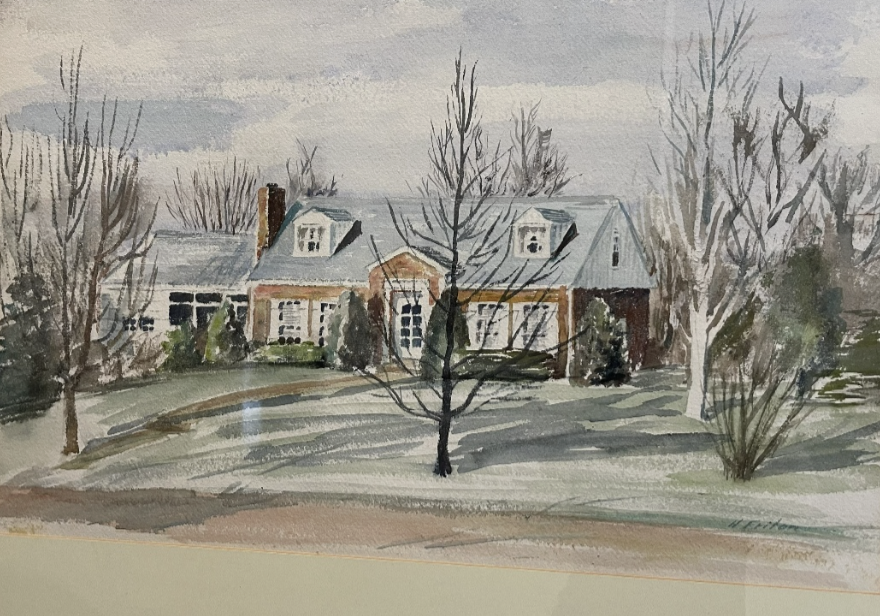
Above: Drawing of the Michel home at 855 Warwick Lane
My father was what I guess you would call a traveling salesman and worked for Fairbanks Morse Company. They sold diesel engines, pumps and that kind of thing. He would sell diesel engines to small communities in southern Illinois for their power plants. His name was John Michel and my mother was Adele.
In the neighborhood, there were four other little girls and like I said, I’m the youngest. We were all about a year apart. We were like sisters. Another girl moved in further up the street and she got into our group. And we’ve kept in contact. Of that group, three were only children: one had an older brother and one had a younger brother, so they were like everyone’s older brother and everyone’s little brother.
We used to play outside until it got dark and each one of us had a different whistle. Our parents would whistle for us. In summer, we would all go home and get our lunch andtake it out on trays and take turns in everyone’s backyard, sitting at picnic tables. Wedid that almost every day for years.
On Manchester, there was a grocery on the east side of Manchester. It might have been named Hardesty’s. That’s where women went for their major groceries. There was a story during the war that he was selling black market meat and many refused to go there. People probably had to go to Kirkwood.
At that time, the Fire Department and city offices were in the same building. When they had council meetings, they pulled the fire truck out so they could have their council meetings.
I went to North Glendale Elementary School and then Nipher Junior High and then Kirkwood High School. We all did except for one of the girls in our group who went to Catholic schools. Two of us graduated in 55 and two in 56. When I went to high school, the high school was located in one of the two buildings that now make up Nipher. The junior high was in the building to the right, facing the school. There was some overlap between the buildings; art was in the high school building and physics, for some unknown reason, was in the junior high building. The cafeteria was located in the junior high building.
We walked to North Glendale. Of course, you had to wear skirts at that time. When it was cold, we would wear slacks under our skirts, and we took them off when we got to school.
All the schools were segregated at that time. Speaking of segregation, they used to have minstrel shows at North Glendale – once a year. One of my friends – her father used to put on black face. Can you imagine? There was one Jewish family in our neighborhood – they built a house up where the barns used to be -- a very nice family with a boy about our age – but I remember people talking about it. Those were different times.
There were no school buses at that time, so we would take the public bus to junior high and high school. There was one on Manchester and another at Sappington and Kirkham. But after just a few months, we started having carpool. Two families had two cars, including mine, so the mothers would drive us.
There was a trolley that ran down by the police station and those little stores down there on Sappington. It went to Kirkwood and also Webster Groves; that was one of the things we used to do as we got a little older. We walked down there and got on the trolley and took it to Webster or Kirkwood and go shopping. In high school we used to walk into Kirkwood and go to Velvet Freeze and then catch the bus from Adams and Kirkwood Road near the church there.
You could also take the trolley – it was real old-fashioned. There were wires overhead and the boys would go out the back and pull the wire off and we would stop. The trolleys connected with the St. Louis streetcars, but I don’t remember how or where. I remember riding St. Louis streetcars in the late 40’s, early 50’s. About that time, they started building shopping like in Clayton where they built a Famous Barr. Another friend and I used to ride the bus over to Clayton as well. By then the trolley had left Glendale.
When I went to North Glendale, I don’t think there was anything across the street from the school, maybe a house. There was a little grocery store at the corner of Kirkham and Sappington called Stecker’s (spelling?). Stecker’s sold everything, including gasoline. The joke was that Mr. Stecker would be in there cutting meat and go out and pump gas, go back and start cutting meat again. The assumption was that he didn’t wash his hands (laughs). This was on the northeast corner and was there for a long time. When welived in Glendale, there were, I believe, two policemen, one of them was the crossing guard. There was a pond near Kirkham that used to freeze in winter, and we would ice skate there. I can’t remember what else was around there.
We had a wonderful childhood. When it snowed, we would go sleigh riding on the street. The city didn’t plow the streets like they do now. I remember one year when my father drove the car up and down the street packing the snow, so we could sleigh ride. We had a driveway that you could flood, and we would ice skate the driveway.
I remember the names of some of my teachers at North Glendale. The kindergarten teacher was Mrs. Featherstone. Her husband was in the war; of course, many of the teachers’ husbands were in the war. I started at Glendale in 43. The principalwas Miss Billings. The first-grade teacher was Miss Winkelmeyer. In second grade was Mrs. Eckerly. Third-grade was Miss Lott and she got married during the time we had her and all her students went to her wedding. Fifth grade was Miss Ashburn and sixth grade was Miss Ruck. Miss Ashburn was a good artist and would teach art to the fifth and sixth graders, and Miss Ruck would teach math; they would switch off. There was one class for every grade – probably 25 or 30 students.
When I started first grade, they had classes that started in January and then they graduated in January. But that same year they stopped having January classes. I had already been put up a half grade, so I got put up another half year. There were several of us who did that. That’s how I ended up graduating early in 55.
Three of us went to Webster Hills Methodist Church in Webster Groves. Mary Queen of Peace was next to it. My husband and I were married at Mary Queen of Peace.
At night we would play hide and seek and kick the can. During the day, we would play with dolls and paper dolls. We used to make things out of Plaster of Paris, mold and paint them. We had lots of coloring books. One of the girls – her name was Mary Frein and lived at 843 – her dad, built this huge swing set and embedded it in concrete. We spent lots of time on those swings. My father built me a playhouse; it was 12 feet by 12 feet and had six-foot ceilings. It was divided into three rooms and a porch. We played out there a lot. My best friend and I used to spend a lot of time playing in that house. When we got older, we had slumber parties out there.
After the Second World War, that’s when area started to develop; that’s when they started building houses and extended Warwick Lane and built houses down there. On our side of the street, the houses were eventually all the way to Sappington, like it is now. Our house was finished in February of 1942; my parents said that they were barely able to finish it because of the war effort. They used to sell savings bonds at school. Once a week, we would take our money – as little as a quarter. When you accumulated $18.75 you got $25 bonds. A lot of my college money actually came from those bonds.
My husband and I both went to Washington University; that’s where we met on a blind date. I graduated from Washington U; he graduated from University of Houston. I have a degree in chemical engineering which was unusual at that time. My husband is an electrical engineer, but we are now both long retired. After we married, we first had an apartment in Brentwood and then I was transferred to Texas City and left in 1962. Over the years, we lived in Ballwin, Missouri; Marshalltown, Iowa; and now we live in Georgetown, Texas, north of Austin.
